
Tangerine
Notes on Smog

Most people think that their love is more wonderful than any other love has ever been. It was my first love. I thought all people felt like we did when they were in love. It was only later that I realized ours was more wonderful than any other.
- Lucia Berlin, Welcome Home
… and when I woke up I removed the shield and looked around and everything looked different. What was I seeing? I was seeing what is always there. The bed, the windows, the walls, the floor. But the brightness of it, the radiance … And the windows, what did I see? A sky of the sheerest wildest blue … Is this the world as it truly looks?
- Don DeLillo, Zero K
I can see clearly now, through my window. Helios’s golden sunrays are melting the remaining piled snow, and the nurse walks by, holding her daughter’s hand, and the shadows of tree branches quiver on the parking lot.
Two Smog albums transport me to my college dorm room: Knock Knock (1999) and Red Apple Falls (1997). I had a small bed and a small desk and a small TV and a small refrigerator and a large bong. I had a fake ID that I used to stock the minifridge with Heinekens. The walls were bare and white. The floor was hard and white. One night I dropped a bottle of Heineken on the floor, and it shattered. Using the edge of a folder, I raked the wet glass into a contained area and covered it with a bathmat. I don’t remember why. Maybe I didn’t have a trash can handy. Maybe I kept the crushed glass like a secret or a premonition, spilled teeth. For weeks, invisible slivers bit my heels when I padded barefoot at night across the floor and into the hall to the bathroom.
In a daze, I went to the nursery and chose flamboyant plants to transform my room into a jungle, but my jungle received insufficient light, and I forgot to water it, and the plants died, and dropped their leaves, and smelled terrible.
Then Maggie moved into my life and added radiance to the room. We listened to Smog. Knock Knock was our falling in love record. It spoke to our dreamful youth—we were the “teenage spaceship[s].” It acknowledged the wreckage of childhood that we’d crept out of, those “cold blooded old times.”
Mother came rushing in
She said we didn’t see a thing
We said we didn’t see a thing
It suggested a more hopeful future together.
Let’s move to the country
Let’s start a …
Let’s have a …
If Knock Knock is grounded in real people, relationships, places, memories, and plans, it’s counterpart Red Apple Falls is a vibrant hallucination, drifting between states of dreaming and sleeplessness. A haunted orchard, ghost carting apples. By the river, a robot “looking for a drink.” Moonlight shines on the “black garden of thorns,” and a crushed cardinal “weep[s] into dead leaves.” Every figure is every other figure. The man dreaming is the ghost, the robot, the red bird, the one who hears the red bird’s cry, the one who finds the red bird’s mangled wings.
And if Knock Knock was our falling in love record, Red Apple Falls was our making love record.
In “To Be of Use,” Bill Callahan intones:
Most of my
fantasies
are of
making someone else come
To be of use
To be of use
Oh, like a spindle
or oh, like a candle
Oh, like a horseshoe
or oh, like a corkscrew
Like that, Maggie and I learned how to fuck together on the dorm room bed, springs squeaking, spring light leaking through the screened window. Sweet sweat and lilac sprigs perfumed the air. And the Absinthe and cider of the music swirled around.
We moved into an apartment on a cul-de-sac.
Collect pots and pans. Collect glasses and silverware and pillowcases. Collect a couch.
Collect habits, routines, collect inside jokes, shared memories, collect pressure points and pet peeves, gripes; collect tantrums, favors, boundaries, hair ties, bread ties, bedtimes, bad times, sweet times, fun times. Collect vinegars, collect recipes, collect the recycling.
Collect phone numbers, collect keys, collect books, collect dreams.
Collect paychecks, bills, pizza orders, hobbies, avocado seeds. Use toothpicks and a small mason jar and set them on the windowsill above the sink so they can drink the light and sprout.
Collect loofahs.
Showers with Maggie—She’s short, so she tented her hands over her head to direct the flow of water to where she wanted it, smiling up at me.
Collect values, collect outfits. Collect cousins and brothers and sisters. Jealousies and friendships and Christmases. Cats. Collect boxes of tea.
Collect Smog CDs.
For me, Dongs of Sevotion (2000) is a social record. I can hear the wry strut of “Dress Sexy for my Funeral”—
Dress sexy for my funeral
my dear wife
for the first time
in your life
—playing through the open window while Maggie and I sit in folding chairs on the porch, gossiping with our downstairs neighbors, Roddy and Beth, the smell of greasy ribeyes on the grill, clinking ice cubes, sticky fingers, lime coating our tongues—it was the summer of margaritas.
Roddy came up in the Athens, Georgia scene of the early 90s, playing drums in a band called Skinner Pilot. He had a story about the boys from R.E.M. asking him to join the group when Bill Berry dropped out. Roddy turned them down; he didn’t want to be a rock star.
He was a rural mailman. Beth worked at a health food store. Their joyful two-year-old Ruben trotted around the yard, his long golden hair streaming like a colt’s.
They teased us: we’d be the next to marry, to have a baby.
Let’s have a …
And Supper (2003) is a driving record—hell, there’s a song on the record called “Driving.”
And the rain washes the price
off our windshield
In Maggie’s boxy red Accord, zipping up and down Riverside to and from the university. Downtown to Laughing Seed or Salsa’s or Doc Chey’s for date nights. South on the parkway to Graveyard Fields for weekend hikes. Down Hwy-25 to Hendersonville to visit my brothers or east on I-40 past Winston-Salem to visit Maggie’s mother and sister in Germanton.
Around the time we moved in together—late spring, 2005—Bill released the final record under his Smog moniker, A River Ain’t Too Much to Love. The music is as warm as a sunlit pasture. It’s a record about looking back a long way, to youth, to family, fondly. And the happy frustration of work. And faith for the colts you know will run next year, every year.
In “Rock Bottom Riser,” Bill sings of gratitude.
I love my mother
I love my father
I love my sisters too
I bought this guitar
To pledge my love
To pledge my love to you
When I met Maggie, she wore razor scars and weighed eighty-seven pounds soaking wet; I was smoking black tar heroin and waiting for something bad to happen … Something good happened. We did our homework and ate tomato soup and black bean salad and watched The Daily Show with John Stewart. Ate ice cream, got well.
I am a rock bottom riser
And I owe it all to you
We finally got our chance to see Smog in the fall of ’06. We drove from Asheville to Charlotte on a school night. The Visulite Theater was small and dim, a concrete box, like a garage. We walked down a couple of steps to the pit area. The greyness of the club was brightened with colorful stage lights and a worn rug in front of the microphone.
Bill stood on the rug. He was accompanied only by Jim White of The Dirty Three who had a compact drum kit and a mysterious contraption that produced ethereal ambient noise.
The set began with a few songs from A River Ain’t Too Much to Love—“Say Valley Maker”; “I Feel Like the Mother of the World”; “The Well”; “In the Pines”; “Drinking at the Dam.”
Bill was handsome, with a little boy’s haircut. He wore his collared shirt with its sleeves rolled to his elbows and the bottom tucked into his jeans. He held his guitar high on his chest and stood stock still as he strummed and sang, grimacing as he sang, as if it was painful to pass the words through his lips.
The crowd was as quiet as a congregation.
Between songs, Bill said only, “Thank you.” The crowd cheered and whistled, and beer bottles clanked into a bin by the bar in the back of the room. Then a hush.
Later in the set, he played Smog classics—“Bathysphere”; “River Guard”; “Blood Red Bird”; “Our Anniversary”; “Cold Blooded Old Times” and a new song (“Sycamore”) with lines about a desire to be the “fire part of fire.”
Once in a while, Bill performed a brief jig, a statue coming to life, shuffling his weight side to side then running in place then standing on one leg like a heron.
Another perfect evening, we caught him in Mount Pleasant, South Carolina with Jonathan from Shearwater and Thor from Swans.
Jonathan opened, his startling voice, all his songs about birds.
It was my twenty-second birthday. Maggie and I had eaten oysters on the half shell and walked on the beach. She was wearing a backless minidress.
Bill and the boys wore thrift store suits. I can’t recall the particulars of that night’s set, except that they played “Diamond Dancer” early on—from Bill’s latest record Woke on a Whaleheart (2007), the first release under his Christian name, without the cloak of smog.
A month earlier, I’d asked Maggie to marry me, and she’d said yes. Then she cried tears of anxiety instead of happiness.
“What’s the matter?”
“How am I supposed to tell my mom?”
Dancing all by herself
Dancing all by herself
“It’s time I gave the world my light”
Diamond dancer
Diamond dancer
After the show, I returned from closing our tab to find Maggie talking to Bill Callahan.
Maggie said maybe we’d go to tomorrow’s show in Columbia.
Bill said, “Please don’t. It’ll be the exact same setlist.”
I told him I was reading Knut Hamsun. That I wanted to be like Knut Hamsun, except for the Nazi stuff.
Bill looked at the ceiling. He said softly, “I remember the one where he runs off to the woods. Pan.”
We rented a venue and printed wedding invitations with the photograph “Rest Energy” on the front, Ulay aiming the arrow at Marina’s heart.
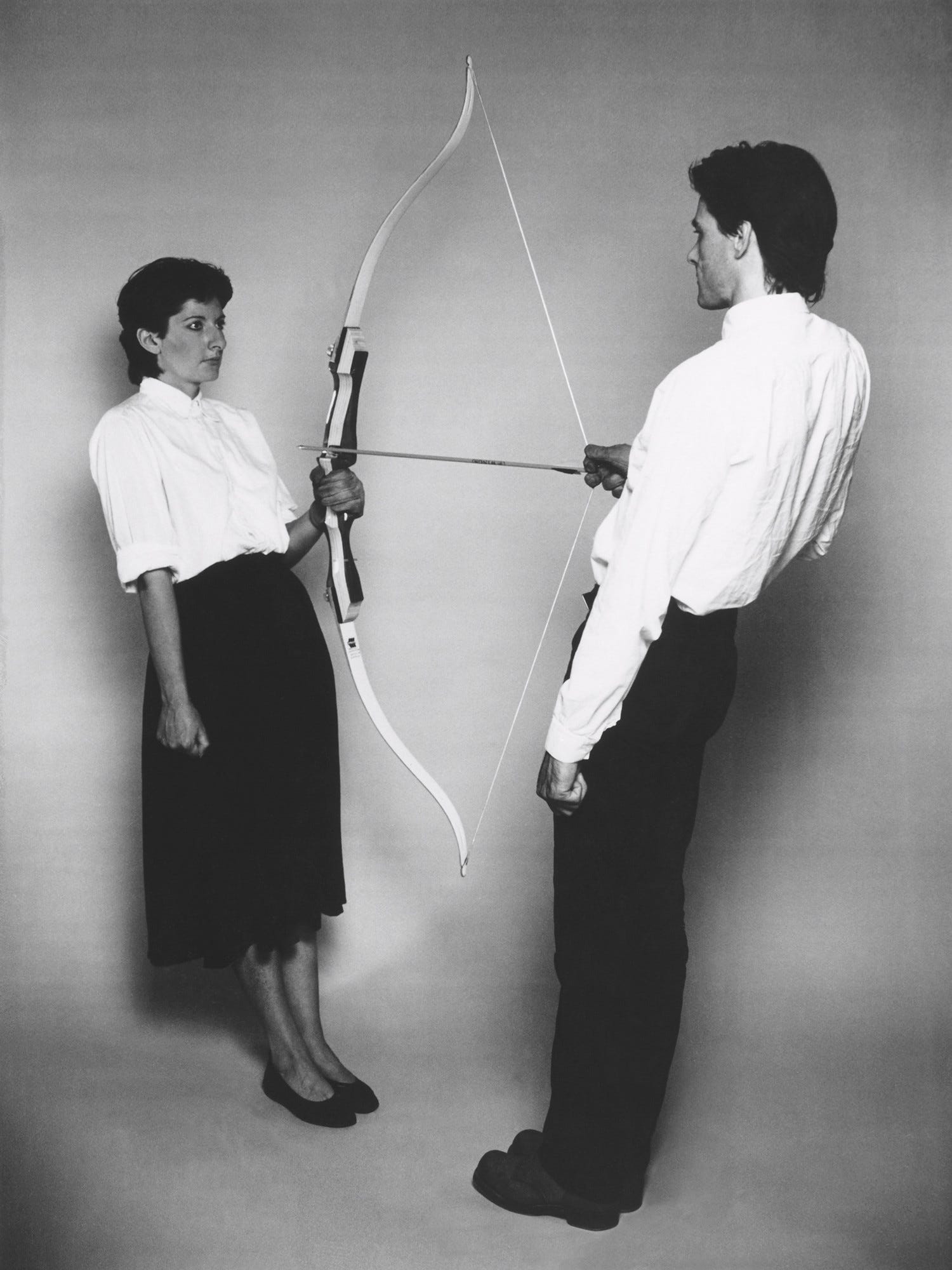
Like an arrow, I was only passing through
We moved from the apartment into a house with a backyard, hardwood floors, and a clawfoot bathtub.
When Maggie left, the tub was filled with her abandoned clothes.
Collect artifacts, collect ghosts.
I sold the collection of Smog CDs. How could I listen to them now?
***
With Marilena, I ran to the broken music box dream of New Orleans then the turquoise drinks of Oregon. The lenses of my eyes drifted further and further out of orbit. I stopped going to many shows because they were dangerous. I fell down a stairwell at a Deerhunter show. I fell into so many holes in Portland … I could get around the city alright during the day, with Marilena holding my elbow, but shows were at night, where the rivers flow, and Marilena would get too … forgetful to protect me, and I would get too forgetful to remind her.
Bill toured behind Shepherd in a Sheepskin Vest (2019) and stopped at the Wonder Ballroom in Portland.
Marilena and I were holding hands, keeping each other steady, moving toward the stage, when a security lady intercepted us and dragged us to the side of the room.
“You’re too inebriated, you have to leave.”
Mari said, “Are you fucking kidding me?”
I said, “Wait. She’s drunk. I’m not. I’m blind. She’s my keeper, so I don’t fall down the stairs.”
Mari said, “That’s right.”
The woman shined a flashlight in my eyes.
“Okay. She has to stay here against the wall.”
She guided me to the front and said, “After the show, I’ll come and get you.”
To the people around us she added, “He’s blind. Be mindful of him.”
Bill was right in front of me, but I couldn’t see him. So I just closed my eyes and listened to him sing.
When the band played “Let Me See the Colts,” the bass notes galloped in my chest. I could feel the beating hooves, but when I tried to imagine the running colts, the horses were blurs in my mind. Not only the horses in front of me, but the horses in my memories, and in my fantasies, and even the horses in my dreams—blurs.
Wearing a paper gown, I was wheeled into a cold, cavernous room. Eddie Van Halen was playing somewhere, which confused me. The solo from “Eruption.”
A blurry man appeared in bright blurry light. Blurry blond hair under a blurry blue cap. Blurry face, blurry smile.
“Have you been put under before?”
“Yes, I love it.”
He chuckled. “I thought you looked like a rock star.”
The brief vast euphoria when the medicine spreads …
Somewhere in outer space, the surgeon sliced open my eyeball, scooped it out like a cantaloupe, and sutured a silicone lens implant to my iris. In the process, he ripped my retina, so he lasered it together and injected a black bubble to hold it in place.
I was even more blind than before because the bubble blacked out the repaired vision.
The surgical liaison forgot to send my Percocet prescription to the pharmacy. It wouldn’t be ready for a few hours. I went home, still painless from the anesthesia.
Marilena had to work—she washed dishes at an Argentinian restaurant—so she left me to doze on the couch in our apartment by Mt. Tabor.
I awoke with amazing pain, blinking, crushed glass.
I felt my way out of the apartment and down the hill to the bus stop by the cherry blossom trees.
The driver recognized me and helped me to a seat up front. I told him where I needed to be dropped off.
I heard bodies scattering away from me.
After a moment, I heard a woman gasp, then speak loudly.
“Sir, your EYE is BLEEDING.”
I touched my face. I was wearing a patch; blood was pooling inside it and leaking out of the bottom.
“Thank you,” I said.
The pharmacist came around the counter and held my hand to help me sign for my medication.
I spent nine days on the couch in a void, listening to short stories on the New Yorker podcast and sipping beer through a metal straw.
Then one morning the bubble popped, and the world flooded in.
I walked slowly down the street … It was too bright, too vibrant, too ripe of a tangerine … it couldn’t be real. The sky was wet blue paint. The green breathed.
I knelt in the grass before a camellia blossom.
***
About a year and a half later, I walked into Bar Maven on SE 62nd and Foster. Silver Jews were playing on the sound system. Tanglewood Numbers (2005).
I told the bartender that I had a superstition that whenever I heard David Berman out in the wild, I took it as a message from God that I was in the right place.
“You’re a Silver Jews guy.”
“Yes.”
“Are you a Smog guy?”
“Of course.”
“You know Bill Callahan is playing a show on Sauvie Island this weekend?”
“No way.”
“Yeah, dude. On a farm.”
A stage was set up under a wild, fantastic oak tree. Pumpkins were arranged atop bales of hay. People drank cider and snacked on ears of corn dipped in chipotle butter. I brought Yulia along with me, and we sat together in the grass as the light softened.
Bill made a joke about Midsommar.
He played without a band. He was still handsome and stoic. He still held his guitar high on his body. He still danced like a heron.
He sang a song called “747” that made me shiver. These lines:
And the blood was wiped from your eyes
This must be the light you saw
That just left you screaming
And this must be the light you saw
Before our eyes could disguise true meaning
I could almost smell lilacs and feel Maggie’s kiss when he played “River Guard” from Knock Knock and “Red Apples” from Red Apple Falls.
He finished the night with his sweetest song, “Say Valley Maker,” the one where he sings:
Take me through the sweet valley
Where your heart blooms
Take me through the sweet valley
Where your heart is covered in dew
My heart was covered in dew. The camellia blossoms were covered in dew. The stars glistened. Maggie dragged me out of the murk. Marilena minded my bleary path. The surgeon plunged his scalpel into my dewy eye. My Helios. My amazing grace.
And Yulia—was Yulia covered in dew?
Yulia was nudging me. The show was over, and she wanted me to go talk to Bill. He was standing by a hay bale, listening to two mothers.
When it was my turn, I shook Bill’s hand and thanked him for another special evening. He just gazed and waited, so I told him the story about meeting him long ago in Mount Pleasant.
Bill looked at the night sky. He said softly, “I remember you. Knut Hamsun.”